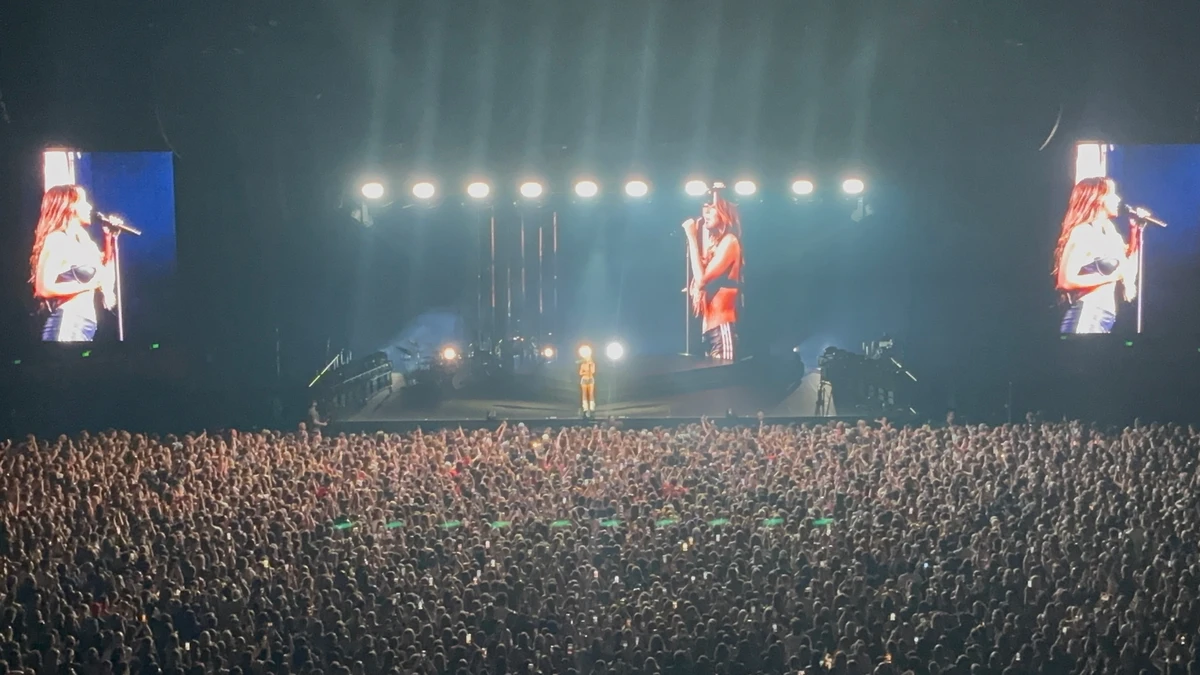


Olivia Rodrigo on stage. The Unraveled Tour opens in Hartford on 25 September.
Olivia Rodrigo on stage. The Unraveled Tour opens in Hartford on 25 September.
Ticketmaster does not usually undo its own sales in public. On Thursday it did exactly that, announcing across its social channels that it had “recovered” a batch of Olivia Rodrigo tickets for The Unraveled Tour and would put them back in front of fans at the original price.
The company’s wording is precise and worth reading twice. The recovered seats, it said, “are ticket purchases that broke the rules of the sales and are being released directly back to fans, at the original prices set by the tour.” In other words: these were bought by people the system was meant to keep out, and Ticketmaster reversed the transactions.
What Ticketmaster Actually Did
The mechanism here is not a resale marketplace intervention. It is cancellation. Purchases that violated the terms of the onsale — bulk buying, bot activity, breaching per-customer limits — were voided, and the inventory returned to Ticketmaster’s own pipeline rather than being left to circulate on secondary sites at whatever the market would bear.
Fans who had not managed to get seats in the original onsale were given priority in the redistribution, as Consequence reported. The request window ran to Friday 21 August at 11:59 p.m. ET, with successful applicants due a status email on Friday 28 August.
The process itself was deliberately narrow. Fans picked their preferred shows, entered payment details and submitted a single request; Ticketmaster warned that submitting one guaranteed nothing, and that a $1 temporary hold might appear on the card and be released if the request failed. Anyone selected is charged automatically once the window closes.
The Dates That Were Left Out
Not every night was included. TicketNews reported that the recovered Olivia Rodrigo tickets excluded the Hartford, Sunrise and Las Vegas shows.
That detail says something about how the recovery worked. This was not a blanket sweep of the tour; it was a set of specific transactions flagged on specific dates. Where nothing was flagged, nothing came back. It is a reminder that the enforcement is transaction-level rather than a general policy of holding prices down.
How Fans Had to Claim Them
The claim route was a request, not a sale, and the distinction shaped the whole exercise. FemaleFirst reported that fans had to select their preferred shows, enter payment information up front and submit one request each, with Ticketmaster stressing that a submission carried no guarantee of seats.
Card details were taken before any allocation was made. Ticketmaster warned that a temporary $1 hold might be placed and would be released if the request came to nothing, and that anyone selected would be charged automatically once the window shut rather than being asked to confirm. Confirmation emails were promised on submission, with a caveat that they might be slow to arrive.
Structurally that is a lottery with a payment method attached, and it is a reasonable design for this problem: a first-come queue is exactly what bulk buyers are built to win, while a request pool with a single entry per person removes most of the speed advantage. It also means the fans who lost out in the original onsale had to commit again, on a deadline, with no idea of the odds.
The $25 Tickets Coming on 1 September
Separately, Ticketmaster confirmed that $25 “Silver Star” tickets go up for request on Tuesday 1 September at 3 p.m. ET. Those are a different scheme from the recovered seats — a deliberately low-priced allocation rather than reclaimed inventory — but they land in the same fortnight and the same conversation.
Set against the rest of the tour’s pricing, the number is striking. Seats for this run were reported earlier in the year at more than $200 in the furthest sections of an arena and close to $800 on the floor, prices that drew enough anger from fans for some to argue publicly that they should be illegal.
Why the Complaint Was Never Only About Rodrigo
TicketNews makes the point plainly: Rodrigo is not an outlier. Fans of Bruce Springsteen, Zach Bryan, Sabrina Carpenter, Sleep Token, Ghost and Green Day have all directed the same criticism at the same company in recent cycles.
That pattern is the actual story. When an arena tour sells out in minutes and a large share of the inventory surfaces immediately on resale at a multiple of face value, fans experience it as one failure with one name attached. The recovery announced this week is an admission that a meaningful number of those purchases were not legitimate in the first place.
There is also a wrinkle in the phrase “face value” itself. The recovered Olivia Rodrigo tickets return at the prices the tour originally set — which, on the floor, were reported at close to $800. A fan rescued from a reseller’s markup is still paying an arena price that generated its own backlash months ago. The recovery fixes the resale premium; it does not touch the number underneath it.
That is why the $25 allocation matters more than it first appears. It is the only part of this fortnight’s announcements that changes what a ticket costs rather than who gets to buy it, and it is capped, requested and rationed accordingly.
What is missing from the announcement is a number. Ticketmaster has not said how many Olivia Rodrigo tickets were recovered, what share of the onsale that represents, or how the offending accounts got through. Without that, it is impossible to judge whether this is a systemic fix or a well-timed gesture.
What It Means for the Tour Itself
The Unraveled Tour opens on 25 September at PeoplesBank Arena in Hartford, Connecticut, with a second night in the same building the following evening. The routing then runs through Pittsburgh, Washington, Charlotte, Chicago, Boston, Montreal, Toronto and Columbus before the end of October, almost entirely in two-night stands.
From November the tour moves through Philadelphia, Atlanta, Orlando, Sunrise and Nashville, then west to Vancouver, Seattle, Oakland, Sacramento and Las Vegas in December. A four-night stand at the Intuit Dome in Los Angeles follows in January, with Brooklyn’s Barclays Center closing things out in February 2027.
The two-night pattern matters for the resale question. Doubling up in each city adds inventory without adding markets, which is one of the few levers an artist genuinely controls against scarcity pricing. A tour built this way is already leaning against the problem Ticketmaster spent Thursday cleaning up. It is the same instinct behind harder-edged experiments elsewhere in live music, like the run we covered where a chart-climbing act leaned on repeat demand rather than one-off spectacle.
The Test Comes at the Next Onsale
Reclaiming Olivia Rodrigo tickets after the fact is the easiest version of this to announce and the hardest to verify. The seats go back at face value, the headlines are good, and the underlying question — why rule-breaking purchases cleared at all — stays unanswered.
The meaningful signal will be whether the same enforcement shows up before the next major onsale rather than three weeks after it, and whether Ticketmaster starts publishing the scale of what it cancels. Until then, fans get a real second chance at a real price, which is more than the previous cycle offered, and rather less than a fix.
This article was AI-assisted and edited for accuracy.
About Author