
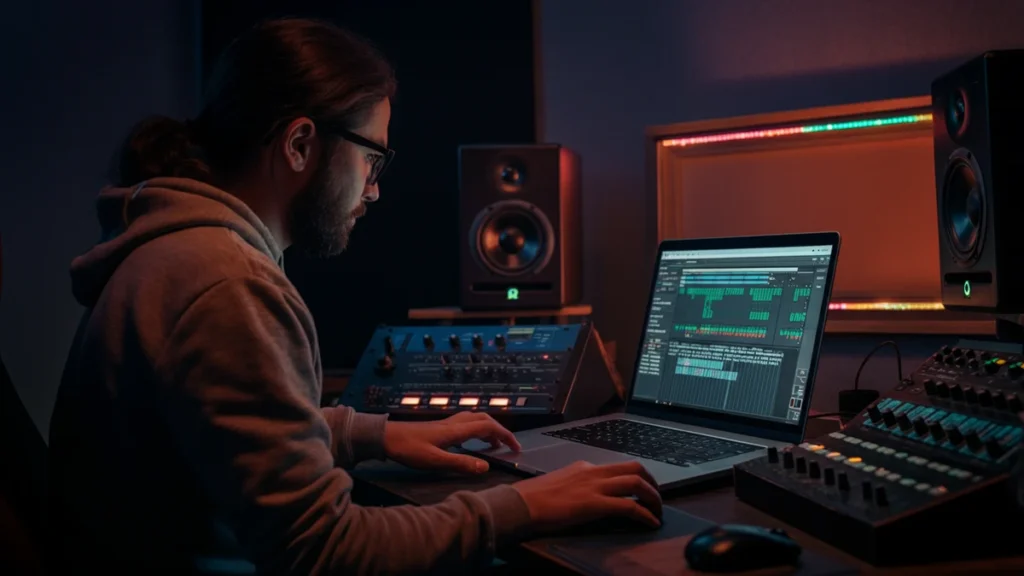
Indie producer using AI mastering tools at a home studio mixing console | TopMusic.news - AI Generated
The New Final Polish: How Indie Producers Are Using AI Mastering Tools
In today’s music production landscape, the line between a bedroom demo and a commercial track is blurring. This is largely thanks to artificial intelligence. For many independent artists, professional mastering was once too expensive and time-consuming. Now, those barriers are falling. This article explores how indie producers are using AI mastering tools in 2026. We will examine key platforms, strategic workflows, and the debate between automated precision and human intuition.
The AI Mastering Ecosystem in 2026
The market for AI mastering is no longer a novelty; it’s a mature ecosystem with several dominant players, each offering a distinct approach to automated audio finishing. Platforms like LANDR, iZotope Ozone, and eMastered have become integral parts of the modern indie workflow.
LANDR, one of the earliest pioneers, has refined its algorithm over a decade, using a massive dataset to inform its mastering decisions. It offers a fast, web-based solution that appeals to producers needing quick turnarounds. Users can upload a track, select a style, and receive a mastered version in minutes, optimized for streaming services.
iZotope Ozone, on the other hand, offers deeper, more surgical control. Its AI Assistant provides a strong starting point based on genre and intent. However, it functions within a full suite of modules that allow for detailed manual tweaking. This makes it a favorite among producers who want AI to assist, not just automate.
Other services like eMastered and platforms like Cryo Mix offer competitive alternatives, often differentiating on user interface, customization options, and specific sonic characteristics. The core technology is similar: machine learning algorithms analyze a track’s dynamics, frequency balance, and stereo width, then apply processing to match professional standards.
The Allure of AI: Speed, Cost, and Consistency
The primary driver for the adoption of AI mastering is undeniable: efficiency. Traditional mastering can cost hundreds of dollars per track and take days or weeks. AI services turn this into a process that costs a fraction of the price and delivers results almost instantly. This speed is a game-changer for independent artists who are frequently releasing singles, creating content for social media, or needing to send polished demos to collaborators.
Consistency is another major benefit. An AI doesn’t have ear fatigue or subjective off-days; it applies a consistent logic to every track, which is particularly useful for creating a cohesive sound across an entire EP or album. Furthermore, these tools have democratized access to a “radio-ready” sound, helping artists meet the loudness and formatting standards required by streaming platforms like Spotify and Apple Music without needing deep technical expertise. This is a crucial step before navigating digital distribution.
Where Human Expertise Still Reigns Supreme
Despite its advantages, AI mastering is not without limitations. But can an algorithm truly feel a song? The most common critique is its lack of emotional intelligence and artistic intuition. A human mastering engineer connects with the artistic intent of a song. They make nuanced decisions to enhance its emotional impact—something an algorithm cannot yet replicate. AI can make a track loud and clear. However, it may struggle to preserve the subtle dynamics of a delicate folk song or the intentional grit of a raw rock track.
This has led to what some call a “one-size-fits-all” approach, where AI can sometimes produce generic or formulaic results. While the technology is constantly improving, it still excels with well-mixed, conventional tracks and can falter when presented with complex, unconventional, or poorly mixed source material. A human engineer can provide critical feedback on the mix itself, a collaborative element that is absent in a purely automated workflow.
A Hybrid Workflow: Integrating AI Without Losing the Human Touch
Rather than a binary choice between human and machine, the most forward-thinking indie producers are using AI mastering tools as part of a hybrid workflow. This approach leverages the strengths of both worlds, combining AI’s efficiency with human creativity. Many producers now use AI as a powerful first-pass or reference tool. They might run a mix through LANDR or Ozone’s assistant to quickly hear how it could sound in a finished state, identify issues in their mix, and get it 80% of the way there.
From there, they have several options:
- For Demos and Social Media: Use the AI-generated master directly for non-critical releases where speed is paramount.
- For Key Releases: Take the AI-generated master as a starting point and perform their own final tweaks, adjusting limiters, EQ, and stereo width to better match their artistic vision.
- For Major Projects: Use the AI master as a high-quality demo to send to a professional human engineer, saving the engineer time on basic adjustments and allowing them to focus on the more creative, final-touch enhancements.
This hybrid model reframes the conversation from “AI vs. human” to “AI and human.”
It treats AI not as a replacement, but as an incredibly powerful assistant. The AI handles the technical heavy lifting, freeing up the artist to focus on creative expression.
The Future of Mastering: Collaboration, Not Replacement
Looking ahead, the integration of AI in music production is set to deepen. The trend is moving away from simple “upload and master” services toward AI-powered plugins that offer real-time assistance within a producer’s Digital Audio Workstation (DAW). The role of the producer is evolving toward that of a curator, guiding AI-generated content—from mastering to generative AI in songwriting—and refining it with their unique perspective. As these tools become more sophisticated, the focus will remain on how indie producers are using AI mastering tools to enhance their creativity, not supplant it. The goal is to strike a balance, leveraging technology to make music production more accessible and efficient while ensuring the final product retains the invaluable human touch.
Explore More on Music Technology
The world of music technology is constantly changing. Stay informed on the latest trends, tools, and industry shifts to keep your productions at the cutting edge. Explore more articles and news to stay ahead of the curve.
For more insights into the latest music technology, visit our homepage at TopMusic.news.
About Author