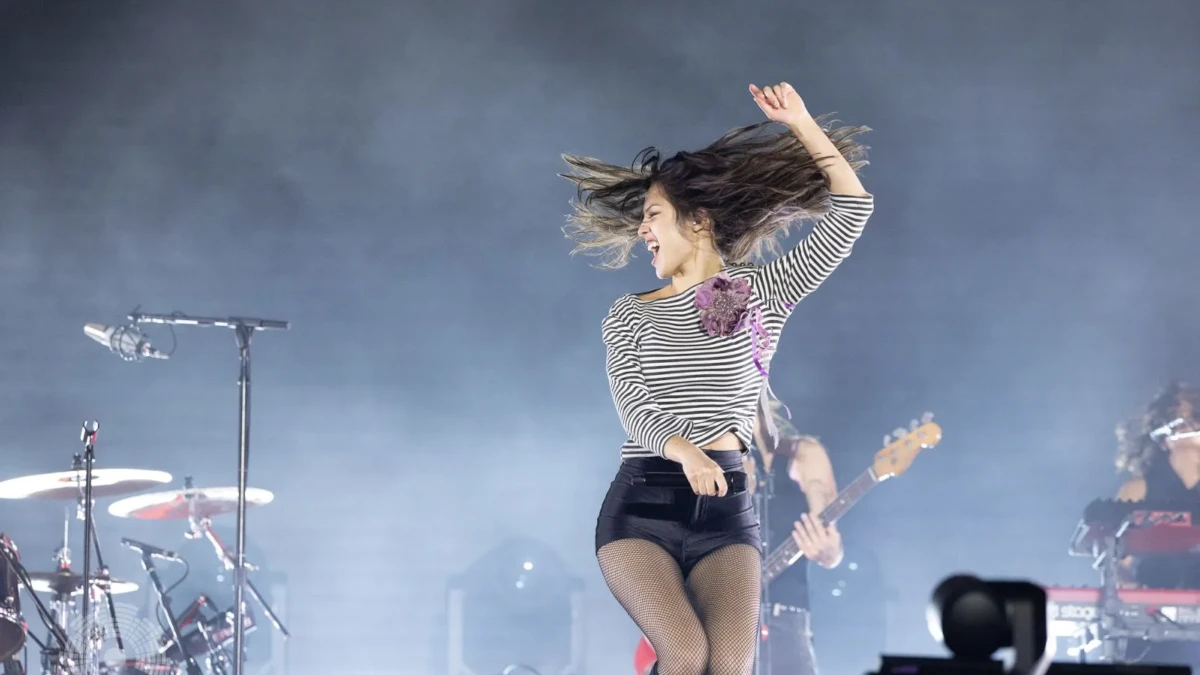

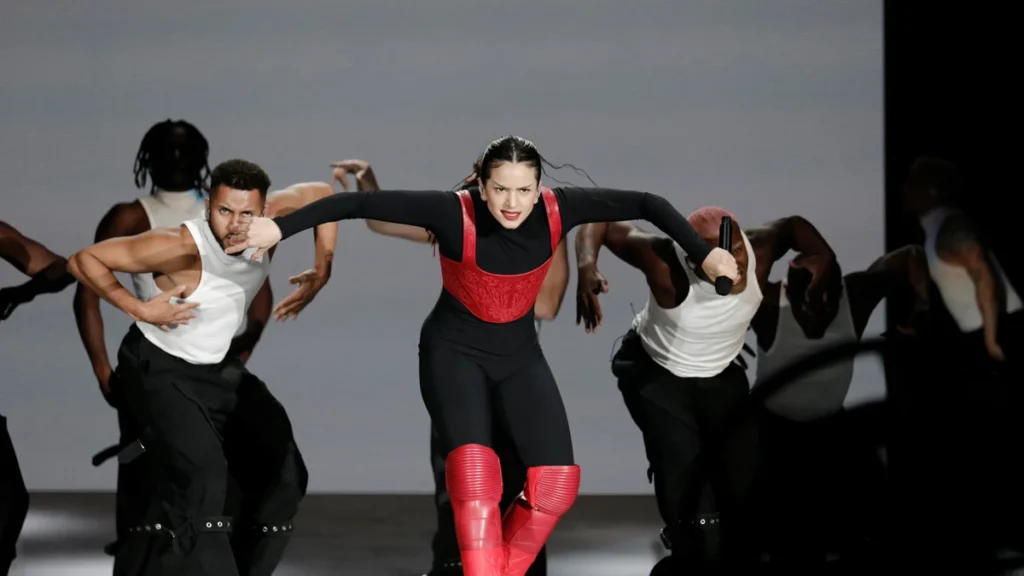
Rosalía performing in Mexico City, where the LUX Tour now has five booked nights.
Rosalía performing in Mexico City, where the LUX Tour now has five booked nights.
The Rosalía LUX Tour is entering its last stretch, and the numbers behind it have quietly become some of the most striking in mainstream pop this year. Forty-two shows. Seventeen countries. An album that set a UK chart record no Spanish female artist had reached before. And a Mexico City residency that has more than doubled in size since the tour was announced.
The run began in Lyon in March and finishes in San Juan in September. Right now it is deep in Latin America, working through arena stands in Chile, Argentina, Brazil and Mexico, and the scale of those bookings tells its own story about where her audience actually sits.
How LUX Rewrote Rosalía’s UK Chart History
The record that started this cycle came in November 2025. LUX debuted at Number 4 on the UK Official Albums Chart, which Official Charts confirmed as the highest-charting album ever by a Spanish female artist on that chart.
The margin is what makes it notable. The previous holder of that record was Rosalía herself, with 2022’s MOTOMAMI, which peaked at Number 42. Moving from 42 to 4 in one album cycle is not incremental growth in a market that has historically been difficult for Spanish-language releases.
Official Charts put it plainly in its chart-week write-up: “Congratulations go to ROSALÍA, who earns a record-breaking personal best this week with her much-talked-about avant-garde classical pop album LUX.”
Context matters for how hard that placing is to reach. The UK albums chart is dominated by English-language releases, and non-English records that break the top five usually arrive with either a film soundtrack or a global streaming phenomenon behind them. LUX had neither. It arrived as an orchestral art-pop album and still landed one place outside the top three.
The lead single moved with it. “Berghain”, featuring Björk and Yves Tumor, reached Number 36 on the Official Singles Chart, the highest-charting UK single of her career as a lead artist. For a track built around orchestral arrangement and multilingual vocals rather than a conventional pop hook, that is an unusual chart outcome.
Forty-Two Shows, Seventeen Countries
The touring plan matched the ambition of the record. According to the Live Nation announcement, the LUX TOUR 2026 covers 42 shows across 17 countries, billed as her biggest headlining run to date.
It opened on 16 March 2026 at the LDLC Arena in Lyon, France, then worked through Europe: France, Switzerland, Italy, Spain, Portugal, the Netherlands, Belgium, Germany and the United Kingdom. Spain got the heaviest concentration, with four nights in Madrid at the end of March and four more in Barcelona in April.
Those Spanish stands are worth pausing on. Eight arena nights split between Madrid and Barcelona is a home-market statement, and it front-loaded the tour with the audience most likely to know the record in depth before it travelled.
North America followed across the United States and Canada. Then the tour turned south for the leg it is in now, which is where the booking pattern gets most aggressive.
The Latin American Leg, Arena by Arena
The Latin American run opened in Bogotá in July and has been stacking multi-night stands ever since. The current schedule, as listed on Live Nation, runs like this:
- Santiago, Chile: Movistar Arena, four nights across late July
- Buenos Aires, Argentina: Movistar Arena, 1, 2, 4 and 6 August
- Rio de Janeiro, Brazil: Farmasi Arena, 10 and 11 August
- Guadalajara, Mexico: Arena VFG, 15 and 16 August
- Monterrey, Mexico: Arena Monterrey, 19 August
- Mexico City: Palacio de los Deportes, 22, 24, 26, 28 and 29 August
- San Juan, Puerto Rico: Coliseo de Puerto Rico, 3 September
Four nights in Santiago and four in Buenos Aires are the kind of numbers usually reserved for artists with a decade of catalogue behind them in those markets. Rosalía is doing it on her fourth album.
The leg also reads as a deliberate sequencing choice rather than a routing convenience. Colombia, Chile and Argentina came first, Brazil sits in the middle, and Mexico closes it out with the largest block of dates on the entire tour. Puerto Rico then takes the finale. It is a run built to end at its loudest point rather than taper off.
Why Mexico City Went From Two Nights to Five
The clearest demand signal on the whole run is in Mexico City. When Live Nation announced the tour, the Mexico City stop was listed as two shows at the Palacio de los Deportes, on 24 and 26 August.
The current listing shows five: 22, 24, 26, 28 and 29 August. Three additional nights were added to a venue that seats in the tens of thousands, in a market that has been central to her audience since well before this album.
That expansion is the sort of adjustment that only happens when the first on-sale clears faster than the promoter planned for. It also means Mexico City now hosts more LUX Tour nights than any city outside Spain.
The Album Behind the Tour: An Orchestra and Fourteen Languages
What makes the chart run more unusual is the record itself. LUX was recorded with the London Symphony Orchestra, conducted by Daníel Bjarnason, and features vocals in fourteen different languages.
Critical response was strong across the board. Live Nation’s announcement collected the reaction: Rolling Stone called it an album that “feels like her most astonishing offer yet, packed with history and decades of training”. AP News wrote that “if there is a single avant-garde saving grace in the pop music landscape, it’s here. It’s maximalist”. NME described “an arresting album of astonishing scope and ambition… that consistently leaves you with your jaw on your floor”.
Those are the notices of a critical record, not a commercial one. The Rosalía LUX Tour is the part of the cycle proving the two can be the same thing.
Where the Run Ends, and What It Sets Up
The tour closes on 3 September 2026 at the Coliseo de Puerto Rico in San Juan. A handful of rescheduled United States dates in Orlando and Miami sit in the calendar after that, but San Juan is the scheduled finish line.
What follows is unannounced. There is no new record trailed, no confirmed next campaign, and nothing beyond a tour that ends in early September. What the cycle has established is more useful than a teaser: a Spanish-language artist working with an orchestra in fourteen languages can chart at Number 4 in the UK, fill five nights in Mexico City, and sell four-night arena stands across South America.
It is a pattern worth watching against how other global acts are scaling right now, something TopMusic.news looked at in its piece on a record-breaking return by one of the biggest groups in the world. Different market, different genre, same underlying shift: audiences outside the traditional Anglo-American centre are increasingly the ones setting the numbers.
There is a practical read on the whole cycle too. An album recorded with a symphony orchestra in fourteen languages is an expensive, difficult record to tour, and the standard expectation would be a short victory lap in a handful of major cities. Instead it produced a 42-date arena run that grew in its biggest market while it was already on sale.
For now the Rosalía LUX Tour has five weeks left to run, and the biggest block of it is in Mexico.
About Author